





Mostrar el registro sencillo del ítem
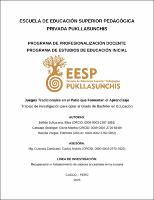
Juegos Tradicionales en el Patio que Fomentan el Aprendizaje
| dc.contributor.advisor | Guevara Zambrano, Carlos Andrés | |
| dc.contributor.author | Bellido Sullcarana, Elisa | es_PE |
| dc.contributor.author | Cancapa Solaligue, Gloria Martha | es_PE |
| dc.contributor.author | Huaylla Vargas, Edelmira | es_PE |
| dc.contributor.editor | Asociación, Pukllasunchis | |
| dc.date.accessioned | 2025-11-27T21:03:44Z | |
| dc.date.available | 2025-11-27T21:03:44Z | |
| dc.date.issued | 2025-11-27 | |
| dc.identifier.uri | http://repositorio.pukllasunchis.org/xmlui/handle/PUK/241 | |
| dc.description.abstract | Resumen Este estudio busca comprender cómo los juegos tradicionales andinos, al estar profundamente arraigados en la cultura local, fomentan el desarrollo de aprendizajes más significativos, y como situados desde un contexto escolar, se puede analizar el impacto de juegos donde representan sus vivencias cotidianas como el turus pukllay, watunachikuy, t’uruwan pukllasun entre otros en el proceso de enseñanza-aprendizaje. El juego no es ajena a la vida cotidiana, es una forma de construir vínculos afectuosos y alegres con la comunidad, no se juega por jugar, los niños aprenden a través del juego las prácticas agrícolas, construcción, música, la danza, la historia de su comunidad, y la conexión con el mundo natural y espiritual, el juego representa lo serán mañana, el juego es anuncio de su vida futura. Estos juegos fortalecen el sentido de pertenencia cultural, y que su inclusión en las prácticas pedagógicas es vital para promover una educación integral y contextualizada. El presente trabajo destaca la importancia de visibilizar los juegos tradicionales andinos como una herramienta educativa clave en la primera infancia. | es_PE |
| dc.description.abstract | Abstract This study seeks to understand how traditional Andean games, being deeply rooted in local culture, encourage the development of more meaningful learning, and how, situated from a school context, the impact of games where they represent their daily experiences such as turus pukllay, watunachikuy, t'uruwan pukllasun among others in the teaching-learning process can be analyzed. Play is not alien to everyday life, it is a way to build affectionate and joyful ties with the community, it is not played for the sake of playing, children learn through play agricultural practices, construction, music, dance, the history of their community, and the connection with the natural and spiritual world, the game represents what they will be tomorrow, the game is an announcement of their future life. These games strengthen the sense of cultural belonging, and that their inclusion in pedagogical practices is vital to promote a comprehensive and contextualized education. This work highlights the importance of making traditional Andean games visible as a key educational tool in early childhood. Keywords: Traditional Games, Learning, Early childhood. | es_PE |
| dc.description.abstract | Pisi Rimayllapi Wisi Pukllaypiqa kawsayninkuta qhawarichikunku, imaymanatachus pukllarichkanku qhawasqankumanhina, kachkan turus pukllay, watunachikuy, t’uruwan pukllasun imaymana pukllaykuna, chayta qhawarikuspayá rimarisuway imaynatachus kay pukllaykunaq uhunta warmakunaq chaninta yachayninkuta kallpachanku. Pukllayqa manaña kawsayninkumantaqa t’aqasachu, astawan sumaq kawsayta ayllumasinchikwan apamun, pukllaypas manam akna pukllayllachu, warmakuna pukllaspa yacharinku chakra rurakuyta, takiyta, ayllunkuq kawsayninta riqsirinku, Pachamamawan kawsayta ima, pukllayqa willakun imaynachá q'aya kawsay kanqa chayta. Kay pukllaykuna astawan kallpacharin ñuqa kayninchikta, chayrayku kay pukllaykuna yachay wasikunapi aswanta pukllarikunman, yanapanmanmi aswan allin yachay kananpaq. Chay rayku kay llank’aypi mast’ariyta munayku imaynataq kay ayllu uhupi kaq pukllanakuna, ñawpa pukllaykuna allinpuni wawakunaq sumaqta chay uhunmantapacha yacharinankupaq. Chanin rimaykuna: Ñawpa Pukllaykuna, Yachay, Ñawpa wawachay kawsay. | es_PE |
| dc.format | application/pdf | es_PE |
| dc.language.iso | spa | es_PE |
| dc.publisher | Asociación Pukllasunchis | es_PE |
| dc.rights | info:eu-repo/semantics/openAccess | es_PE |
| dc.rights.uri | https://creativecommons.org/licenses/by-nc-sa/4.0/ | es_PE |
| dc.subject | Juegos Tradicionales | es_PE |
| dc.subject | Primaria infancia | es_PE |
| dc.subject | aprendizaje | es_PE |
| dc.title | Juegos Tradicionales en el Patio que Fomentan el Aprendizaje | es_PE |
| dc.type | info:eu-repo/semantics/bachelorThesis | es_PE |
| dc.type.version | info:eu-repo/semantics/publishedVersion | es_PE |
| dc.publisher.country | PE | es_PE |
| dc.subject.ocde | https://purl.org/pe-repo/ocde/ford#5.03.01 | es_PE |
| renati.advisor.orcid | https://orcid.org/0000-0002-2972-3929 | es_PE |
| renati.type | https://purl.org/pe-repo/renati/type#trabajoDeInvestigacion | es_PE |
| renati.level | https://purl.org/pe-repo/renati/level#bachiller | es_PE |
| renati.discipline | 111016 | es_PE |
| renati.juror | Eguiluz Duffy, Cecilia María | es_PE |
| renati.juror | Guevara Valdivia, María Graciela | es_PE |
| renati.juror | Marmanillo Valer, Cintya | es_PE |
| thesis.degree.name | Bachiller en Educación Inicial | es_PE |
| thesis.degree.discipline | Educación Inicial | es_PE |
| thesis.degree.grantor | Escuela de Educación Superior Pedagógica Privada Pukllasunchis | es_PE |
| renati.author.dni | 24716894 | |
| renati.author.dni | 23941266 | |
| renati.author.dni | 24715614 | |
| renati.advisor.cext | 001918674 |
Ficheros en el ítem
Este ítem aparece en la(s) siguiente(s) colección(ones)
-
Educación Inicial [40]

Excepto si se señala otra cosa, la licencia del ítem se describe como info:eu-repo/semantics/openAccess