



Mostrar el registro sencillo del ítem
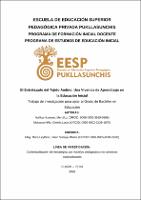
El Entrelazado del Tejido Andino: Una Vivencia de Aprendizaje en la Educación Inicial
| dc.contributor.advisor | Mora Leython, Farah Soraya Milena | |
| dc.contributor.author | Huillca Huaman, Merdiluz | es_PE |
| dc.contributor.author | Morocco Nifla, Cinthia Lucia | es_PE |
| dc.contributor.editor | Asociación, Pukllasunchis | |
| dc.date.accessioned | 2026-04-23T21:46:11Z | |
| dc.date.available | 2026-04-23T21:46:11Z | |
| dc.date.issued | 2026-04-14 | |
| dc.identifier.uri | http://repositorio.pukllasunchis.org/xmlui/handle/PUK/252 | |
| dc.description.abstract | Esta revisión documentada incide en el estudio de los saberes ancestrales sobre el entrelazado del tejido andino. Constituye un aporte que continuará con la transmisión de conocimientos y principios de la cosmovisión andina que, en nuestro territorio, es una actividad que permanece viva durante siglos. El origen, la práctica de técnicas, las destrezas en varones y mujeres y la funcionalidad, etc., son rasgos ineludibles tanto de la vivencia social y cultural, como de la organización social y política, que instituyó vivencias de reciprocidad entre el Estado del antiguo Tawantinsuyu y sus pobladores. Así, la relevancia de estas acciones se aproxima a las que convergen en las perspectivas de procesos educativos, es decir, con las estrategias didácticas para niñas y niños del ciclo II. Por ello, se examinan los fundamentos teóricos acerca de los temas que permiten estrechar lazos entre la matriz identitaria cultural con estrategias pedagógica en el Nivel Inicial en el área de psicomotricidad. En ese sentido, la actividad de tejido es un potencial para reconsiderar aspectos sobre las percepciones y la sensorialidad en edad temprana. De ahí la propuesta de investigación que consiste en activaciones culturales locales en el DCBN en el nivel inicial. | es_PE |
| dc.description.abstract | Abstract This documented review focuses on the study of ancestral knowledge about the interweaving of Andean textiles. It constitutes a contribution that will continue the transmission of knowledge and principles of the Andean worldview, which, in our territory, is an activity that has remained alive for centuries. The origin, the practice of techniques, the skills of men and women, and functionality, etc., are unavoidable features of both the social and cultural experience, as well as the social and political organization, which instituted experiences of reciprocity between the State of the ancient Tawantinsuyu and its inhabitants. Thus, the relevance of these actions is close to those that converge in the perspectives of educational processes, that is, with teaching strategies for children in Early Childhood Education. Therefore, this document examines the theoretical foundations regarding topics that allow for closer ties between the cultural identity matrix and pedagogical strategies in the Early Childhood Level in the area of psychomotor skills. In this sense, the weaving activity offers the potential to reconsider aspects of the perceptions and sensoriality of young children. Hence the importance of incorporating this knowledge into curriculum development at the Early Childhood Level. Keywords: Preeschool education, andean textiles, perceptions, sensations, teaching strategies. | es_PE |
| dc.description.abstract | Pisi rimayllapi willasayki Kay qillqasqa qawariyqa, ñawpa taytakunapa yachayninkunata yachaypim qawarikun, chay pachakuna andinokunapa chaqrusqa kayninmanta. Chayqa huk yanapakuymi, chaymi hinallataqmi puririchinqa yachaykunata, kamachikuykunata, pacha qhawariy andino nisqamanta, chaymi, territorionchispiqa, pachak watakunaña kawsaq ruway. Origen, técnicas nisqakuna ruway, qhari warmi yachay, hinallataq funcionalidad, hukkunapas, mana ayqenapaq hinan kanku, iskaynin experiencia social nisqapipas, cultural nisqapipas, hinallataq organizacion social y política nisqapipas, chaymi sayarichirqan experiencias de reciprocidad nisqakunata Estado de la antigua Tawantinsuyu nisqawan chaypi tiyaqkunawan. Chaynapim, kay ruwaykunapa allin kayninqa hichpallapim kachkan, chaykunam tupan chay procesos educativos nisqapa qawariyninkunapi, chaymi Educación Infantil nisqapi warmakunapaq yachachiy estrategias nisqawan. Chayraykum kay qillqasqaqa qawarin fundamento teórico nisqakunata, temakunamanta, chaykunam permiten aswan allinta tupanachiy matriz de identidad culturalwan estrategias pedagógicas nisqawan Nivel de Infancia Temprana nisqapi, área de habilidades psicomotoras nisqapi. Kay yuyaypiqa, awasqa ruwayqa, huch’uy wawakunaq qhawariyninkunamanta, sensorialidadninmanta ima aspectokunata yapamanta qhawarinapaq atiyta haywarin. Chayraykum kay yachaykunata Nivel Infantil nisqapi curriculum nisqa wiñachiyman churayqa ancha allin. Chanin rimaykuna: Tejido andina, percepciones, sensaciones, estrategias de enseñanza. | es_PE |
| dc.format | application/pdf | es_PE |
| dc.language.iso | spa | es_PE |
| dc.publisher | Asociación Pukllasunchis | es_PE |
| dc.rights | http://purl.org/coar/access_right/c_abf2 | es_PE |
| dc.rights.uri | https://creativecommons.org/licenses/by-nc-sa/4.0/ | es_PE |
| dc.subject | Tejido andino | es_PE |
| dc.subject | Educación Inicial | es_PE |
| dc.subject | estrategias didácticas | es_PE |
| dc.title | El Entrelazado del Tejido Andino: Una Vivencia de Aprendizaje en la Educación Inicial | es_PE |
| dc.type | info:eu-repo/semantics/bachelorThesis | es_PE |
| dc.type.version | info:eu-repo/semantics/publishedVersion | es_PE |
| dc.publisher.country | PE | es_PE |
| dc.subject.ocde | https://purl.org/pe-repo/ocde/ford#5.03.01 | es_PE |
| renati.advisor.orcid | https://orcid.org/0009-0005-8590-3536 | es_PE |
| renati.type | https://purl.org/pe-repo/renati/type#trabajoDeInvestigacion | es_PE |
| renati.level | https://purl.org/pe-repo/renati/level#bachiller | es_PE |
| renati.discipline | 111016 | es_PE |
| renati.juror | Eguiluz Duffy, Cecilia María | es_PE |
| renati.juror | Guevara Zambrano, Carlos Andrés | es_PE |
| renati.juror | Mar Salgado, Lourdes Cecilia | es_PE |
| thesis.degree.name | Bachiller en Educación Inicial | es_PE |
| thesis.degree.discipline | Educación Inicial | es_PE |
| thesis.degree.grantor | Escuela de Educación Superior Pedagógica Privada Pukllasunchis | es_PE |
| renati.author.dni | 75998420 | |
| renati.author.dni | 73786269 | |
| renati.advisor.dni | 09940004 |
Ficheros en el ítem
Este ítem aparece en la(s) siguiente(s) colección(ones)
-
Educación Inicial [40]

Excepto si se señala otra cosa, la licencia del ítem se describe como http://purl.org/coar/access_right/c_abf2