



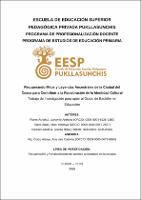
Recuperando Mitos y Leyendas Ancestrales de la Ciudad del Cusco para Contribuir a la Revaloración de la Identidad Cultural
Fecha
2026-04-14Metadatos
Mostrar el registro completo del ítemResumen
En el presente Trabajo de Investigación se analizan los temas centrales de la investigación, los Mitos y Leyendas en la Cosmovisión Andina del Cusco, la Identidad Cultural desde el contexto pedagógico y la Estrategia Pedagógica de la Revalorización. En el primer capítulo se hablar por una parte del mito, según autores como Mircea Eliade y Lévi-Strauss, es un relato sagrado que explica el origen del mundo, las instituciones y las costumbres, conectando a la comunidad con un tiempo primordial. Existen mitos cosmogónicos, antropogónicos, heroicos, fundacionales y escatológicos. La leyenda, en cambio, combina hechos reales y elementos sobrenaturales, busca educar y entretener, y refuerza valores e identidad local. En el capítulo dos, se menciona desde el contexto cusqueño, cómo estos relatos fortalecen el sentido de pertenencia, transmiten saberes ancestrales y mantienen viva la herencia incaica. La oralidad es clave en su preservación y adaptación, mientras que la cosmovisión andina resalta la relación armónica entre ser humano y naturaleza, visible en lugares sagrados y símbolos como el puma, el cóndor y el amaru. Finalmente, en el útlimo capítulo se reflexiona desde el ámbito educativo, las narraciones orales y las competencias narrativas promueven identidad, cohesión social y pensamiento crítico. Revalorizar mitos y leyendas en la escuela contribuye a preservar la cultura, fortalecer el orgullo cusqueño y construir una identidad dinámica e intercultural. Abstract
This research paper analyzes the central themes of the investigation: Myths and Legends in the Andean Cosmovision of Cusco, Cultural Identity from a pedagogical perspective, and the Pedagogical Strategy of Revaluation. The first chapter discusses myth, which, according to authors such as Mircea Eliade and Lévi-Strauss, is a sacred narrative that explains the origin of the world, institutions, and customs, connecting the community to a primordial time. There are cosmogonic, anthropogonic, heroic, foundational, and eschatological myths. Legend, on the other hand, combines real events with supernatural elements, seeks to educate and entertain, and reinforces local values and identity. Chapter two, from the Cusco context, discusses how these narratives strengthen the sense of belonging, transmit ancestral knowledge, and keep the Inca heritage alive. Oral tradition is key to its preservation and adaptation, while the Andean worldview highlights the harmonious relationship between humankind and nature, visible in sacred places and symbols such as the puma, the condor, and the amaru (a mythical creature). Finally, the last chapter reflects on the educational perspective, noting that oral narratives and narrative skills promote identity, social cohesion, and critical thinking. Revaluing myths and legends in schools contributes to preserving culture, strengthening Cusco pride, and building a dynamic and intercultural identity.
Keywords: Intercultural Education, Myths and Legends, Cultural Identity, Oral Tradition. Pisiy Rimayllapi Willasayki
Kay yachay maskay qillqasqaqa, investigacionpa chawpi kaqninkunatam qawarin: Mitos y Leyendas en la Cosmovisión Andina de Cusco, Identidad Cultural de perspectiva pedagógica, Estrategia Pedagógica de Revaloración. Ñawpaq kaq rakipiqa rimakunmi mito nisqamanta, Mircea Eliade, Lévi-Strauss hina qillqaqkunapa nisqanman hinaqa, sagrado willakuymi, kay pachapa, institucionkunapa, costumbrenkunapa paqarimuyninta sut’inchaspa, llaqtata huk ñawpaq pachawan tinkuchispa. Kanmi mitos cosmogónicos, antropogónicos, heroicos, fundamentales, escatológicos nisqakuna. Leyendataqmi ichaqa cheqaq sucesokunata elemento sobrenatural nisqawan tupachin, yachachiyta, kusirichiyta ima maskhan, hinallataq llaqtaq valorninkunata, identidad nisqatapas kallpachan. Iskay kaq t’aqa, Cusco contextomanta, rimakun imaynatas kay willakuykunaqa perteneciente nisqa yuyayta kallpachan, ñawpa yachaykunata apachin, hinallataq inka herenciata kawsachin. Tradición oral nisqa llaveqa waqaychasqa kananpaq, allinchakunanpaqpas, andino pacha qhawariytaqmi resaltan runawan pachamamawan allinta tupasqankuta, ch’uya cheqaskunapi, puma, cóndor, amaru (mitica nisqa kawsaq) hina simbulukunapipas rikukun. Tukuchanapaqtaq, qhipa kaq rakipiqa, yachay qhawariypi yuyaymanakun, chaypiqa qhawarikunmi, rimaywan willakuykuna, willakuy yachaykuna ima, kikin kayta, runapura kuskachakuyta, allin yuyayniyuq kayta ima kallpachan. Yachay wasikunapi mitokunata, leyendakunata musuqmanta chaninchaspaqa yanapanmi culturata waqaychayta, Cusco orgullo nisqa kallpanchayta, chaynallataq identidad dinámica y intercultural nisqa hatarichinapaq.
Chanin rimaykuna: Educación Intercultural, Mitos y Leyendas, Identidad Cultural, Tradición Oral.
Colecciones
- Educación Primaria [12]

Excepto si se señala otra cosa, la licencia del ítem se describe como http://purl.org/coar/access_right/c_abf2