


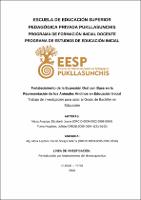
Fortalecimiento de la Expresión Oral con Base en la Representación de los Animales Andinos en Educación Inicial
Fecha
2026-04-30Metadatos
Mostrar el registro completo del ítemResumen
La expresión oral en niñas y niños de Educación Inicial es una competencia lingüística fundamental que permite comprender el lenguaje humano en contraste con otras formas de comunicación. Sin embargo, en contextos urbanos y rurales donde persisten la lengua y cultura quechua, existen brechas en el desarrollo de habilidades comunicativas propuestas en el currículo, como el uso del lenguaje no verbal y paraverbal, así como la coherencia en la expresión de ideas. Ante ello, la representación de animales andinos mediante sonidos onomatopéyicos se plantea como una estrategia didáctica que fortalece estas habilidades desde talleres pedagógicos. La presencia histórica de los animales en actividades como el pastoreo y la agricultura refleja la continuidad y resistencia de la oralidad andina, expresada en prácticas como señas, relatos y producciones culturales, incluyendo las de José María Arguedas. En conjunto, los enfoques revisados destacan la importancia de la pertinencia cultural en el proceso de adquisición del lenguaje, abarcando niveles como el fonológico, léxico, semántico, sintáctico, etimológico y discursivo, lo que contribuye a una formación comunicativa integral. Abstract
Oral expression in Early Childhood Education, as a fundamental linguistic competence, introduces students to the distinction between the development of human language and that of animals. However, in both urban and rural contexts, which legitimize the continuity and practices of Quechua language and culture, there are perceived gaps in learning experiences to address the basic skills outlined in the curriculum design program, such as non-verbal and paraverbal language; coherent and cohesive expression of ideas, among others. In this regard, the representation of the roles and characteristics of Andean animals, using onomatopoeic sounds, provides a pathway for the teacher in the classroom to guide the development of the proposed competence through didactic workshops. For this reason, the relevance of this documented review lies in allowing us to position how the prominence of animals—since their appearance and coexistence in herding and agricultural activities up to the present day—has enriched the Andean worldview, as well as oral tradition narratives; knowledge and cultural practices such as señas y secretos; texts on the subject by the author José María Arguedas; and the imitation of onomatopoeic sounds. In this way, the approaches studied by the authors and the selected thematic axes have enabled us to understand and reflect on the sense of cultural relevance to emphasize the levels of language acquisition; that is, the phonological, lexical, semantic, syntactic, etymological, and discursive levels.
Keywords: andean animals; andean worldview; señas y secretos; oral expression; non-verbal and paraverbal language; didactic workshops Pisirimayllapi willasayki:
Wawa warmi, wawa qhari simi rimay, Educación Inicial pi, runasimi manta rikhuriy, hukninwan kallpanchasqa yachachiy kawsaykunata runa simiwan utaq uywakuna siminta ama qhichwasimiyuqmanta rikuchin. Chaymanta, llaqtapi utaq ayllupi, qhichwa simiwan, qhichwa yachaykunawan kawsayta qhispichispa, yachaykunapi pisiñam kashan — mana qillqay simiwan, mana qhaway simiwan, rimaykunata alli tantispa rimayta atispa, chay qillqay kawsaykunata tarikun, imaymana yachaykunapi, mana qhawariqkunawan rimanapaq, tantikuywan rimanapaq, hinallataq. Chay raykupi, uywakuna andinospa rurukuna, sut'iyuq rimaykunawan, yachachiq warmikuna yachachiq qharikuna willakuykunata churaspa, rimanakuq tinkuykunata ruraypa, yachachiy kallpanchasqapa. Chaymi kay yachay willaypi, ñawpa kawsay andino qhapaqkunamanta, uywakunaqmi ruraykuna, michiykunapi, chakra llamk'aykunapi, kunan kawsaykama, sumaq yachaymanta kamachiyta apamun; chay hina, runasimipi willakuykunamanta, yachaykunamanta, kausay allin kaykunamanta, José María Arguedaspa qillqaykunamanta; hinallataq, uywakunaq sut’iyuq rimaykunamanta. Kayñam yachachiqkunaq willaykunata qhawaykuy, yachaykunaq chaninta rikch’arispa, runa simi yachaykunapaq — qillqay simi, rimay simi, rimaykunapa tinkuy, simi t'ukuy, simi suti, simi llapa rimanakuy.
Chanin rimaykuna: uywakuna andinos; andino yachay; allin kaykunamanta; runa simi rimay; mana qillqay simiwan rimay; yachachiy tinkuy.
Colecciones
- Educación Inicial [43]

Excepto si se señala otra cosa, la licencia del ítem se describe como http://purl.org/coar/access_right/c_abf2