
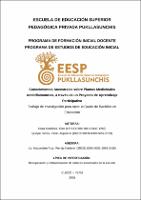
Conocimientos Ancestrales sobre Plantas Medicinales Antiinflamatorias, a través de un Proyecto de Aprendizaje Participativo
Fecha
2026-07-27Metadatos
Mostrar el registro completo del ítemResumen
La investigación aborda la importancia de plantas medicinales como parte fundamental de conocimientos ancestrales, integrándose en la educación mediante un proyecto de aprendizaje. En relación con las plantas medicinales, se consideran los aportes de Justo Mantilla, Grimaldo Rengifo y el libro Qora, editada por la Municipalidad provincial de San Jerónimo, quienes destacan que estas no solo poseen propiedades curativas, sino que también forman parte de la vida y cosmovisión de las comunidades. En los andes, las plantas son consideradas seres vivos con ánima, familia y género, porque su uso medicinal implica respeto y prácticas responsables. Respecto a conocimientos ancestrales, se toman en cuenta aportes de Grimaldo Rengifo, la Organización Mundial de la Salud (OMS) y la teoría del aprendizaje significativo de David Ausubel. Estos planteamientos resaltan el valor de saberes tradicionales como parte de la identidad cultural y señalan la importancia de incorporarlos en el proceso educativo, favoreciendo aprendizajes significativos vinculados con la experiencia y el contexto de los estudiantes. Finalmente, el proyecto de aprendizaje se fundamenta con aportes del Ministerio de Educación del Perú, John Dewey y Mariali Cárdenas, quienes sostienen que esta estrategia pedagógica promueve la participación de los niños y niñas, permitiéndoles explorar, plantear preguntas y buscar soluciones a problemas de su interés, generando aprendizajes significativos dentro y fuera del aula. Abstract
This research addresses the importance of medicinal plants as a fundamental part of ancestral knowledge, integrating it into education through a learning project. Regarding medicinal plants, the contributions of Julio Mantilla, Grimaldo Rengifo, and the book Qora are considered, highlighting that these plants not only possess healing properties but also form part of the life and worldview of the communities. In the Andean world, plants are considered living beings with a soul, family, and gender, so their medicinal use implies respect and responsible practices. Regarding ancestral knowledge, the contributions of Rengifo, the World Health Organization (WHO), and David Ausubel's theory of meaningful learning are taken into account. These approaches highlight the value of traditional knowledge as part of cultural identity and emphasize the importance of incorporating it into the educational process, fostering meaningful learning linked to students' experiences and contexts. Finally, the learning project is based on the contributions of the Ministry of Education of Peru, John Dewey and Cárdenas Salceda, who maintain that this pedagogical strategy promotes the active participation of children, allowing them to explore, ask questions and seek solutions to problems of interest to them, generating meaningful learning inside and outside the classroom.
Keywords: Ancestral Knowledge, Medicinal Plants, Participatory Learning Project, Intercultural Education. Pisi Rimayllapi Willasayki
Kay t’uqtinayqa ancha chaniyuq hampi qurakunamanta, ancha chaninchasqa kaynintan qhawarin, ñawpaq yachaypa fundamentalnin nisqata, riqsiyninta yachayninta ñawpaq yachaykunata kay yachay proyectowan. Hampi qurakunawan tupachispaqa, Julio Mantillaq, Grimaldo Rengifoq, Qora qillqaynintan yanapakuyninkunatan qhawarinku, paykunan aswanta rimanku kaykunamanta manas hampiyniyuqllachu, aswanqa llaqtakunaq kawsayninpi, cosmovisión nisqapipas kasqankuta. Kay Andino pachapiqa qurakunataqa kawsaqmi kanku animunkuwan aylluyuq hinaspa qari warmi kayninkumanta, chaymi hampiypi llamk’ayninqa amachaywan, responsable kay ruwaykunawan. Ñawpa yachaykunamantaqa, Rengifo, Organización Mundial de la Salud (OMS) nisqapa, David Ausubelpa teoría de aprendizaje significativo nisqaq yanapayninkunatan qhawarinku. Kay hamawt’aykunaqa qhawarichinmi ñawpaqmanta pacha yachaypa chanin kayninta identidad cultural nisqamanta pacha, chhaynallataqmi qhawarichin yachay puriyman churay ancha allin kasqanmanta pacha, chaywanmi kallpachakun allin yachaykunata yachapakuqkunaq yachaynimanta pacha hinaspa yachaqkunbaq ayllunmanta.
Chanin rimaykuna: Ñawpa yachay, Hampi Qurakuna, Proyecto de Aprendizaje Participativo, Educación Intercultural
Colecciones
- Educación Inicial [40]

Excepto si se señala otra cosa, la licencia del ítem se describe como http://purl.org/coar/access_right/c_abf2