



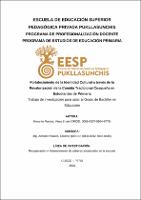
Fortalecimiento de la Identidad Cultural a través de la Revalorización de la Comida Tradicional Cusqueña en Estudiantes de Primaria
Fecha
2026-07-31Metadatos
Mostrar el registro completo del ítemResumen
El presente documento expone las bases teóricas de la investigación **“Fortalecimiento de la Identidad Cultural a través de la revalorización de la Comida Tradicional Cusqueña en estudiantes de primaria”**, cuyo objetivo es elaborar material educativo que promueva la valoración de la comida tradicional cusqueña como estrategia para fortalecer la identidad cultural de los estudiantes. Para ello, se revisaron diversas fuentes nacionales e internacionales sobre los conceptos de comida tradicional, identidad cultural y material educativo. La propuesta busca que los estudiantes reconozcan el valor cultural de los alimentos que forman parte de su vida cotidiana y fortalezcan su sentido de pertenencia. Aunque la comida tradicional cusqueña sigue presente en muchas familias, cada vez son más los hogares jóvenes que dejan de prepararla, lo que reduce su consumo en las nuevas generaciones y favorece la preferencia por alimentos procesados y menos saludables. Ante esta situación, la investigación propone preservar y revalorizar los conocimientos y prácticas relacionados con la elaboración y el consumo de la comida tradicional, transmitidos de generación en generación. Estos saberes expresan la historia, los valores y la diversidad cultural del pueblo cusqueño, contribuyendo al fortalecimiento de la identidad cultural, la cohesión social y la conservación del patrimonio biológico y cultural. Abstract
This document presents the theoretical foundations of the research "Cultural Identity through the Revaluation of Traditional Cusco Food in Elementary School Students." The objective of this research is to develop educational materials that values traditional Cusco food to strengthen students' cultural identity. To achieve this objective, various national and international texts that define the concepts of traditional food, cultural identity, and educational materials were analyzed. With this work, I hope that primary school students, through a daily activity such as eating, will strengthen their cultural identity. Traditional Cusco food is not foreign to children; it is part of their daily diet, and at least once in their lives, they have seen how it is prepared. Although this practice is present in Cusco society, it is observed that many young families, for the most part, are stopping preparing it, thus generating a decrease in its consumption among new generations. As a consequence, it lacks appreciation for it and, consequently, a preference for consuming processed, precooked, and unhealthy foods. In response to this, this research aims to preserve and strengthen cultural practices linked to the preparation and consumption of traditional Cusco food. These practices were inherited by our ancestors and passed down from one generation to the next. These practices tell the story of a people through their ingredients and flavors, indirectly promoting a sense of belonging, cultural identity, and social cohesion, as well as the preservation of biological and cultural diversity.
Keywords: Traditional food, cultural identity, educational material. Pisirimayllapi willasayki
Kay qillqasqaqa "La identidad cultural a través de la revalorización de la comida tradicional cusqueña en estudiantes de primaria" nisqa investigacionpa teórico nisqa cimientonkunatan qhawarichin, kay yachay maskaypa munayninqa, material educativo nisqa ruwaymi, chaymi chaninchan tradicional Qusqu mikhuykunata, wayna sipaskunaq identidad cultural nisqa kallpanchanapaq. Kay yuyayta wiñachinapaq, chikan mamallaqtamanta hinallataq mamallaktamantapas qillqasqakunatan t’aqwikamurqan, chaykunapin ñawpa mikhuna, identidad cultural, material educativo ima yuyaykunata churasqaku. Kay llamk’aywanmi suyachkani primariapi wayna sipaskuna, sapa p’unchaw ruwayninkupi,, mikhuyninkupi ima, identidad culturalninkuta kallpanchanankuta. Ñawpaq Qusqu mikhuykunaqa manan warmakunapaq waq mikhuychu; aswanpas sapa p’unchaw mikhusqankuq hukninmi, huk kutillapas kawsayninkupi, paykunaqa qhawarqanku imaynata wayk’ukun chaytan. Kay ruwayqa Qusqu llaqtanchispi kachkanmi, ichaqa qhawarikunmi achkha wayna ayllukunapi, yaqa llapampi manaña wakichisqankuta, chaynapi musuq miraykunaq mikhuynin pisipasqanmanta. Chaytaq apamun, allin mikhuykunata mana chaninpaq hap’iy, aswantaqmi munanku procesado mikhuyta, ñawpaqmanta wayk’usqa, mana qhali mikhuyta ima. Kayta kutichispan, kay mask’ayqa, Qusqumanta ñawpaqmantapacha mikhuy wakichiywan, kawsay ruwaykunata waqaychayta, kallpachayta ima munan. Kay ruraykunataqa ñawpa taytanchiskunamantan herenciata hinan chaskinchis huk miraymanta huk mirayman qusqan karqan. Kay ruwaykunan willakun huk llaqtaq willakuyninta mikhunaq kaqninkunawan, q’apariyninwan ima, kaywantaq kallpachan sentido de pertenencia, identidad cultural, cohesión social nisqakunata, hinallataq diversidad biológica, cultural ima nisqa waqaychayta.
Chanin rimaykuna: Ñawpaq mikhuy, identidad cultural, material educativo.
Colecciones
- Educación Primaria [12]

Excepto si se señala otra cosa, la licencia del ítem se describe como http://purl.org/coar/access_right/c_abf2