



Mostrar el registro sencillo del ítem
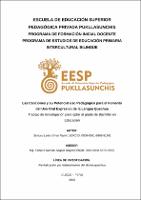
Las Canciones y su Potencial uso Pedagógico para el Fomento del Uso Oral Expresivo de la Lengua Quechua
| dc.contributor.advisor | Farfán Huamán, Miguel Ángel | |
| dc.contributor.author | Soncco León, Omar Ramiro | es_PE |
| dc.contributor.editor | Asociación, Pukllasunchis | |
| dc.date.accessioned | 2025-11-12T22:37:49Z | |
| dc.date.available | 2025-11-12T22:37:49Z | |
| dc.date.issued | 2025-11-12 | |
| dc.identifier.uri | http://repositorio.pukllasunchis.org/xmlui/handle/PUK/232 | |
| dc.description.abstract | Resumen Un desafío central de la Educación Intercultural Bilingüe (EIB) es la incorporación del quechua como lengua viva y de uso cotidiano en contextos escolares. A pesar de su riqueza cultural, el quechua aún es relegado en muchos espacios educativos a un rol pasivo, limitado a actividades puntuales o de folclorización. Asimismo, un mundo globalizado y homogeneizado hace que esta lengua necesite presencia, no solo en el ámbito escolar, sino también en todos los espacios sociales. Por ello, la presente investigación documental se centra en construir un marco teórico sobre el fomento del uso oral expresivo del quechua a través de las canciones. Esto debido a que las canciones no solo preservan al quechua como lengua viva, sino que actúan como fuente de conocimiento y transmisión cultural. Por lo mismo, a través de una profunda revisión teórica, este trabajo se organiza en tres ejes: la situación del quechua en la educación peruana, la oralidad en el mundo andino y el uso de canciones en la escuela. | es_PE |
| dc.description.abstract | Abstract A central challenge of Intercultural Bilingual Education (IBE) is the incorporation of Quechua as a living language for everyday use in school contexts. Despite its cultural richness, Quechua is still relegated to a passive role in many educational settings, limited to specific activities or folkloric contexts. Furthermore, in a globalized and homogenized world, this language needs to be present not only in schools but also in all social spaces. Therefore, this documentary research focuses on constructing a theoretical framework for promoting the expressive oral use of Quechua through songs. This is because songs not only preserve Quechua as a living language but also act as a source of knowledge and a vehicle for cultural transmission. Therefore, through an in-depth theoretical review, this work is organized into three areas: the situation of Quechua in Peruvian education, oral tradition in the Andean world, and the use of songs in schools. Keywords: Intercultural Bilingual Education, Songs in Quechua, Promotion of Quechua. | es_PE |
| dc.description.abstract | Pisi Rimayllapi Willasayki Educación Intercultural Bilingüe nisqapim huk hatun sasachakuy kachkan, imanaptinchus manam qichwa siminchik yachay wasikunapi rimarikapuchkanñachu hinllataq pisiyapuchkan ima. Imaymana chanin yachayninkunaña kaptinpas, yachay wasikunapiqa qichwa siminchikqa sarunchasqam tarikun, mayñin mayñin mayñinllapiñam rimarikun, munaycharinapap imallanam rimarikum. Hinallataq, tiqsi muyu aswan kikinchasqa hukllachasqa hina kawsaypim qichwa siminchikqa aswanta ñawpaqman tanqarispa lliwman rikurichina, ichaqa manam yachay wasikunallapichu, tukuy runap kawsayninkunapim qichwa simiqa tarikunan. Chay raykum kay qillqa mayt’ukuna t’aqwiriyqa qichwa simipi rimayta takikunap chawpinta kallpachariymanmi chanincharikum. Imaraykuchus, takikunaqa manam qichwa simillatachu waqaycharin, aswanqa imaymana ayllukunap yachaynintam mast’arin qhipa wiñaykunaman. Hina kaptinmi, kay t’aqwiriyqa kimsa iqikunatam qatipam: qichwa simi Perú suyup yachay wasinkunapi, ayllu runakunap imaymachus rimaynim, yachay wasikunapi qichwa simi. Chanin rimaykuna: Educación Intercultural Bilingue, Qichwa simipi takikuna, Qichwa simi kallpachariy. | es_PE |
| dc.format | application/pdf | es_PE |
| dc.language.iso | spa | es_PE |
| dc.publisher | Asociación Pukllasunchis | es_PE |
| dc.rights | info:eu-repo/semantics/openAccess | es_PE |
| dc.rights.uri | https://creativecommons.org/licenses/by-nc-sa/4.0/ | es_PE |
| dc.subject | Educación Intercultural Bilingüe | es_PE |
| dc.subject | Canciones en Quechua | es_PE |
| dc.subject | Fomento del Quechua | es_PE |
| dc.title | Las Canciones y su Potencial uso Pedagógico para el Fomento del Uso Oral Expresivo de la Lengua Quechua | es_PE |
| dc.type | info:eu-repo/semantics/bachelorThesis | es_PE |
| dc.type.version | info:eu-repo/semantics/publishedVersion | es_PE |
| dc.publisher.country | PE | es_PE |
| dc.subject.ocde | https://purl.org/pe-repo/ocde/ford#5.03.01 | es_PE |
| renati.advisor.orcid | https://orcid.org/0009-0008-5973-3555 | es_PE |
| renati.type | https://purl.org/pe-repo/renati/type#trabajoDeInvestigacion | es_PE |
| renati.level | https://purl.org/pe-repo/renati/level#bachiller | es_PE |
| renati.discipline | 112096 | es_PE |
| renati.juror | Eguiluz Duffy, Cecilia María | es_PE |
| renati.juror | Guevara Zambrano, Carlos Andrés | es_PE |
| renati.juror | Zea Sanchéz, Bacilio | es_PE |
| thesis.degree.name | Bachiller en Educación Primaria Intercultural Bilingüe | es_PE |
| thesis.degree.discipline | Educación Primaria Intercultural Bilingüe | es_PE |
| thesis.degree.grantor | Escuela de Educación Superior Pedagógica Privada Pukllasunchis | es_PE |
| renati.author.dni | 73938218 | |
| renati.advisor.dni | 45571308 |
Ficheros en el ítem
Este ítem aparece en la(s) siguiente(s) colección(ones)

Excepto si se señala otra cosa, la licencia del ítem se describe como info:eu-repo/semantics/openAccess