





Mostrar el registro sencillo del ítem
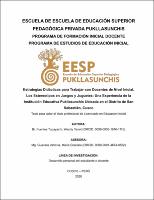
Estrategias Didácticas para Trabajar con Docentes de Nivel Inicial, Los Estereotipos en Juegos y Juguetes: Una Experiencia de la Institución Educativa Pukllasunchis Ubicada en el Distrito de San Sebastián, Cusco
| dc.contributor.advisor | Guevara Valdivia, María Graciela | |
| dc.contributor.author | Fuentes Tupayachi, Wendy Yanet | es_PE |
| dc.contributor.editor | Asociación, Pukllasunchis | |
| dc.date.accessioned | 2026-04-23T17:39:38Z | |
| dc.date.available | 2026-04-23T17:39:38Z | |
| dc.date.issued | 2026-04-14 | |
| dc.identifier.uri | http://repositorio.pukllasunchis.org/xmlui/handle/PUK/249 | |
| dc.description.abstract | En la presente investigación se abordó la temática de los estereotipos en juegos y juguetes como recurso didáctico para trabajar con docentes de educación inicial la desestereotipación en las prácticas lúdicas con niños y niñas. El objetivo fue reconocer las percepciones, limitaciones y actitudes de los docentes frente a los estereotipos de género, así como proponer estrategias pedagógicas que promuevan el uso de juegos no estereotipados en el aprendizaje infantil. El estudio, de enfoque cualitativo y naturaleza descriptiva, se desarrolló con docentes de la Institución Educativa Pukllasunchis, en el distrito de San Sebastián, Cusco. Se realizaron entrevistas a 05 docentes, organizando la información según temas y categorías. Los objetivos específicos fueron: identificar las percepciones de los docentes sobre los estereotipos en los juegos, reconocer las dificultades al abordar el tema y recopilar estrategias didácticas que fomenten la igualdad de género en las dinámicas lúdicas. Las conclusiones a las que se pudo llegar es que, si incluimos estrategias didácticas para trabajar la no estereotipación de género en los juegos y juguetes, tendríamos niños y niñas libres, seguros de sí mismos, con mayor confianza, favoreciendo el crecimiento y desarrollo social y emocional del niño. | es_PE |
| dc.description.abstract | Abstract This research addressed the issue of stereotypes in games and toys as a teaching resource for early childhood educators to work on de-stereotyping in play practices with boys and girls. The objective was to identify teachers' perceptions, limitations, and attitudes toward gender stereotypes, as well as to propose pedagogical strategies that promote the use of non-stereotypical games in early childhood learning. The study, with a qualitative and descriptive approach, was conducted with teachers from the Pukllasunchis Educational Institution in the district of San Sebastián, Cusco. Interviews were conducted with five teachers, and the information was organized according to themes and categories. The specific objectives were: to identify teachers' perceptions of stereotypes in games, to recognize the difficulties in addressing the topic, and to compile teaching strategies that promote gender equality in play activities. The conclusion reached is that if we include educational strategies to address gender stereotypes in games and toys, we would have children who are freer, more self-assured, and more confident, thus fostering their social and emotional growth and development. Keywords: stereotypes, strategies, games, toys, child learning, social development. | es_PE |
| dc.description.abstract | Pisiy Rimayllapi Kay maskayqa pukllaykunapi, pukllanakunapipas estereotipos nisqamanta rimarirqa, yachachinapaq yanapakuy hina, warmachakunapa yachachiqninkunapaq, qari warmakunawan, warmi warmakunawan pukllay ruwaykunapi desestereotipo nisqapi llamkanankupaq. Chaypaqmi karqan yachachiqkunaq qhawarisqankuta, limitacionninkuta, actitudninkutapas estereotipos de género nisqamanta, hinallataqmi estrategias pedagógicas nisqakunata churanapaq, chaykunan kallpachan mana estereotípico nisqa pukllaykunata qallariy wawakunaq yachaypi. Kay estudio cualitativo, descriptivo nisqa, Cusco suyupi San Sebastián distritupi, Institución Educativa Pukllasunchismanta yachachiqkunawan ruwakurqa. Pichqa yachachiqkunawanmi tapuykunata ruwarqaku, chaymantam willakuykunataqa temaman hina hinaspa categoría nisqaman hina organizarqaku. Chay objetivos específicos nisqakunaqa karqan yachachiqkunaq pukllaykunapi estereotipo nisqamanta qhawarisqankuta reqsinankupaq, chay temamanta rimaspa sasachakuykunawan tupasqankuta reqsinankupaq, hinallataq yachachinapaq estrategiakunaq huñunankupaq, chaykunan pukllay ruwaykunapi qhari warmi kaqlla kayta kallpachan. Tukuchiyman chayasqanchikqa, sichus pukllaykunapi, pukllanakunapipas qari warmi kayninkumanta estereotipokunata qawarinapaq estrategias educativas nisqakunata churasunman chayqa, aswan libre, aswan kikinkumanta seguro, aswan confianzayuq wawakunayuqmi kasunman, chaynapim wiñayninku hinaspa wiñayninku social hinaspa emocional nisqapi kallpanchasqa kanmanku. Chanin rimaykuna: estereotipos, estrategias, pukllaykuna, pukllanakuna, wawa yachay, desarrollo social. | es_PE |
| dc.format | application/pdf | es_PE |
| dc.language.iso | spa | es_PE |
| dc.publisher | Asociación Pukllasunchis | es_PE |
| dc.rights | http://purl.org/coar/access_right/c_abf2 | es_PE |
| dc.rights.uri | https://creativecommons.org/licenses/by-nc-sa/4.0/ | es_PE |
| dc.subject | aprendizaje infantil | es_PE |
| dc.subject | desarrollo social | es_PE |
| dc.subject | estrategias | es_PE |
| dc.title | Estrategias Didácticas para Trabajar con Docentes de Nivel Inicial, Los Estereotipos en Juegos y Juguetes: Una Experiencia de la Institución Educativa Pukllasunchis Ubicada en el Distrito de San Sebastián, Cusco | es_PE |
| dc.type | info:eu-repo/semantics/bachelorThesis | es_PE |
| dc.type.version | info:eu-repo/semantics/publishedVersion | es_PE |
| dc.publisher.country | PE | es_PE |
| dc.subject.ocde | https://purl.org/pe-repo/ocde/ford#5.03.01 | es_PE |
| renati.advisor.orcid | https://orcid.org/0009-0001-4674-0552 | es_PE |
| renati.type | https://purl.org/pe-repo/renati/type#tesis | es_PE |
| renati.level | https://purl.org/pe-repo/renati/level#tituloProfesional | es_PE |
| renati.discipline | 111016 | es_PE |
| renati.juror | Eguiluz Duffy, Cecilia María | es_PE |
| renati.juror | Guevara Zambrano, Carlos Andrés | es_PE |
| renati.juror | Mar Salgado, Lourdes Cecilia | es_PE |
| thesis.degree.name | Licenciado en Educación Inicial | es_PE |
| thesis.degree.discipline | Educación Inicial | es_PE |
| thesis.degree.grantor | Escuela de Educación Superior Pedagógica Privada Pukllasunchis | es_PE |
| renati.author.dni | 78886737 | |
| renati.advisor.dni | 23983513 |
Ficheros en el ítem
Este ítem aparece en la(s) siguiente(s) colección(ones)
-
Educación Inicial [29]

Excepto si se señala otra cosa, la licencia del ítem se describe como http://purl.org/coar/access_right/c_abf2