




Mostrar el registro sencillo del ítem
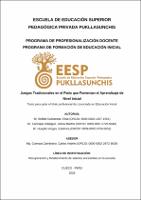
Juegos Tradicionales en el Patio que Fomentan el Aprendizaje de Nivel Inicial
| dc.contributor.advisor | Guevara Zambrano, Carlos Andrés | |
| dc.contributor.author | Bellido Sullcarana, Elisa | es_PE |
| dc.contributor.author | Cancapa Solaligue, Gloria Martha | es_PE |
| dc.contributor.author | Huaylla Vargas, Edelmira | es_PE |
| dc.contributor.editor | Asociación, Pukllasunchis | |
| dc.date.accessioned | 2026-05-05T17:23:27Z | |
| dc.date.available | 2026-05-05T17:23:27Z | |
| dc.date.issued | 2026-05-04 | |
| dc.identifier.uri | http://repositorio.pukllasunchis.org/xmlui/handle/PUK/260 | |
| dc.description.abstract | Esta investigación describe los juegos tradicionales que practican los niños de 4 y 5 años, reconociendo el valor pedagógico y cultural de estos. Utilizando un enfoque cualitativo e intercultural, con entrevistas a niños, padres de familia, profesoras y sabios de la comunidad, quienes aportaron sus experiencias y conocimientos ancestrales. Este diálogo permitió identificar y sistematizar los juegos tradicionales, comprendiendo su función en la formación integral de la infancia. Los resultados evidencian que los juegos tradicionales no solamente fomentan el aprendizaje cognitivo, motriz y social, sino que también constituyen un espacio de transmisión cultural, donde se preservan valores comunitarios como la solidaridad, el respeto, la identidad y reciprocidad local. Asimismo, se constató que estos juegos fortalecen el aprendizaje de los niños y generan un ambiente de aprendizaje significativo, en la educación formal se nutre de los saberes ancestrales. En resumen, los juegos tradicionales en el patio se consolidan como un plan de enseñanza, capaz de integrar la memoria colectiva de la comunidad con las prácticas pedagógicas modernas. De este modo, se reafirma que el aprendizaje en la niñez chumbivilcana se enriquece cuando se reconoce la importancia de las costumbres del lugar y se valora la sabiduría de los pueblos originarios. | es_PE |
| dc.description.abstract | Abstract This research with the purpose of observing, describing and categorizing the traditional games practiced by children of 4 and 5 years old in the playground, recognizing their pedagogical and cultural value. The study was based on a qualitative and intercultural approach, using as main techniques interviews with children, parents, teachers and wise men of the community, who contributed their experiences and ancestral knowledge. This dialogue made it possible to identify and systematize traditional games, understanding their role in the integral formation of children. The results show that traditional games not only promote cognitive, motor and social learning, but also constitute a space for cultural transmission, where community values such as solidarity, respect, identity and local reciprocity are preserved. Likewise, it was found that these games strengthen children's learning and generate a significant learning environment, in formal education it is nourished by ancestral knowledge. In short, traditional playground games are consolidated as a teaching plan, capable of integrating the collective memory of the community with modern pedagogical practices. In this way, it is reaffirmed that learning in Chumbivilcas children is enriched when the importance of the customs of the place is recognized and the wisdom of the native peoples is valued. Keywords: Traditional games, Integral Development of Learning. | es_PE |
| dc.description.abstract | Pisi Rimayllapi Willasayki Wawakunaq pukllayninpiqa kawsayninkutan qhawarichikunku, imaraykuchus paykunaqa wawakunahina pukllarinku qhawarisqankumanhina, hinan kachkan kay mast’ariypi pukllaykuna: Turus pukllay, watunachikuy, t’uruwan pukllasun, wasqha sinp’ay, arre caballito imaymana pikllaykuna, chayta qhawarispan rimarisunchis imaynatachus kay pukllakunaq ukhunta wawakunaq chaninchayninku yachayninkuta kallpacharispanku. Pukllaykunaqa manañan kawsayninchismantaqa t’aqasqachu aswantan sumaq kawsayta ayllumasinchiswan apamun, hinallataq kay pukllaykuna manan aqna pukllayllachu, warmanchiskunaqa pukllaspankuqa yachariyninkunatan mat’iparinku chakra ruraykunapi, uywakunawan, sapa p’unchaw rurayninkunawan, ayllunkuq kawsayninkunapi ima, hinallataq paykunaqa riqsirinku pachamamanchiswan kawsayta ima, pukllaykunaqa willariwasunmanmi imaynachus qaya hamuq pachakunapi, imaynatachus wawakuna kuraq kaspanku kankuman. Kay pukllayninchiskunan astawan kallpacharin sapankaq ñuqa kayninchista, sasachaykuna allchaypi, rimanakuyninkupi, warma masinkunawan kawsayta ima, chayraykun kay pukllaykuna yachay wasikunapi aswanta pukllarikunman, yanapaynin aswan allin mat’iparisqa kananpaq hinallataq aswan allin yachaykuna puririnanpaq, chayrayku kay llank’aypi mast’ariyta munayku, imaynataq kay ayllu ukhupi kay pukllaykuna allinpuni warmakunaq chay ukhumantapacha yacharinankupaq. Chanin rimaykuna: ñawpa pukllaykuna, yachay | es_PE |
| dc.format | application/pdf | es_PE |
| dc.language.iso | spa | es_PE |
| dc.publisher | Asociación Pukllasunchis | es_PE |
| dc.rights | http://purl.org/coar/access_right/c_abf2 | es_PE |
| dc.rights.uri | https://creativecommons.org/licenses/by-nc-sa/4.0/ | es_PE |
| dc.subject | Juegos Tradicionales | es_PE |
| dc.subject | Desarrollo Integral del Aprendizaje | es_PE |
| dc.subject | Educación intercultural | es_PE |
| dc.title | Juegos Tradicionales en el Patio que Fomentan el Aprendizaje de Nivel Inicial | es_PE |
| dc.type | info:eu-repo/semantics/bachelorThesis | es_PE |
| dc.type.version | info:eu-repo/semantics/publishedVersion | es_PE |
| dc.publisher.country | PE | es_PE |
| dc.subject.ocde | https://purl.org/pe-repo/ocde/ford#5.03.01 | es_PE |
| renati.advisor.orcid | https://orcid.org/0000-0002-2972-3929 | es_PE |
| renati.type | https://purl.org/pe-repo/renati/type#tesis | es_PE |
| renati.level | https://purl.org/pe-repo/renati/level#tituloProfesional | es_PE |
| renati.discipline | 111016 | es_PE |
| renati.juror | Eguiluz Duffy, Cecilia María | es_PE |
| renati.juror | Guevara Valdivia, María Graciela | es_PE |
| renati.juror | Marmanillo Valer, Cintya | es_PE |
| thesis.degree.name | Licenciado en Educación Inicial | es_PE |
| thesis.degree.discipline | Educación Inicial | es_PE |
| thesis.degree.grantor | Escuela de Educación Superior Pedagógica Privada Pukllasunchis | es_PE |
| renati.author.dni | 24716894 | |
| renati.author.dni | 23941266 | |
| renati.author.dni | 24715614 | |
| renati.advisor.cext | 001918674 |
Ficheros en el ítem
Este ítem aparece en la(s) siguiente(s) colección(ones)
-
Educación Inicial [29]

Excepto si se señala otra cosa, la licencia del ítem se describe como http://purl.org/coar/access_right/c_abf2