



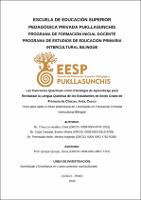
Las Canciones Quechuas como Estrategia de Aprendizaje para Revitalizar la Lengua Quechua de los Estudiantes de Sexto Grado de Primaria de Chacan, Anta, Cusco
Fecha
2026-08-27Metadatos
Mostrar el registro completo del ítemResumen
El Perú posee una valiosa diversidad lingüística y cultural que enfrenta un creciente riesgo, especialmente en las comunidades andinas y amazónicas. La globalización, la influencia de los medios de comunicación y la escasa valoración de las lenguas originarias han contribuido a la disminución del uso del quechua y al debilitamiento de la identidad cultural de los estudiantes. Esta problemática se agrava por la limitada formación de docentes en Educación Intercultural Bilingüe (EIB) y la falta de estrategias metodológicas adecuadas para la enseñanza de la lengua materna. Frente a esta realidad, la investigación “Las canciones en quechua como estrategia de aprendizaje” tiene como objetivo revitalizar y fortalecer el quechua mediante el uso de canciones como recurso pedagógico. Desde un enfoque cualitativo y vivencial, se busca promover la expresión oral, valorar la identidad lingüística y preservar los saberes ancestrales transmitidos a través del canto. Asimismo, esta propuesta constituye una estrategia innovadora para los docentes de EIB, favoreciendo aprendizajes significativos y el fortalecimiento de la identidad cultural de los estudiantes. Abstract
Our country has great linguistic and cultural diversity, a wealth that is currently at risk, especially in the Andean-Amazonian communities. Globalization and the media are leading students to lose their sense of belonging and cultural identity. This problem is evident in both rural and urban educational institutions. For the Ministry of Education, through DIGEIBIRA, this challenge is exacerbated by the shortage of teachers trained in Intercultural Bilingual Education (EIB), as well as by the lack of mastery of appropriate methodological strategies for this type of teaching. Therefore, in light of this reality, the main objective of this research, entitled "Quechua Songs as a Learning Strategy," is to contribute to the revitalization and strengthening of the native language. Through the use of Quechua songs, the goal is to enrich vocabulary, especially to foster appreciation for students' culture and linguistic identity, while keeping alive the cultural practices of their communities. Quechua songs have a deep emotional connection with those who listen to or perform them, as they convey experiences, feelings, and ancestral knowledge. Therefore, this work will be very useful for IBE teachers, motivating them to implement innovative strategies that contribute to the development of a strong cultural identity and
the achievement of truly meaningful learning in their students.
Keywords: Cultural identity, Intercultural Bilingual Education, Revitalization, Quechua Songs, Learning Strategies.
Pisiy Rimayllapi Willasayki
Suyunchikqa llasaq ñawpa simiyuqmi, kawsayniyuq lliw kaqninchikkuna kay p’unchaykuna sasachaypi tarikun, aswantaraq anti yunka llaqtakunapi. Tiqsi kawsaykuna, kaqllataq willakuykuna yachaqikunata pisipayachin ayllu saphinkunapi, kaykuna qhawarikun llaqta yachaq wasikunapi, ayllu yachay wasikunapi ima. Kay sasackakuymi aswan kay Ministerio de Educación, DIGEIBIRApaq ima, kaykuna kachkan pisi EIB t’aqapi yachachiqkuna kaqtin, kaqllataq mana ayllukunaq kawsayninmanhina yachaykunata tupachiqtinku. Kaykuna qhawarikuqtinmi, kay sutichasqa k’uskiykunata wakichichkayku.“Qichwa simipi takikuna, yachaykunapaq mat’ipasqa”, kaywanmi aswanta munakun mama simita kallpachanapaq, qichwa simi takikunaq chawpinta, rimaykunata, qhillqayninkuta qhapaqyachinapaq, aswantaraq ruwaykunawan, riqsiykunawan kawsayninkuta munakunakupaq.Qichwapi takikunaqa anchatapunin sunqunachin pikunachus uyariqkunata, kaqllataq takiqkunata, tatikunaq sunquntan rimakun kawsaymanta, sunquq llakikuyninmanta, kusikuyninmanta hinallataq ñawpaq kawsaykunamantawan. Chaymi kay k`uskisqaqa ancha yanapakuq kanqa EIB yachachiqkunapaq, kaywancha paykunapas qhawarinqaku, aysarinqaku huqniraq yachachiyta warmakunaq allin saphichakunankupaq.
Chanin rimaykuna: Kawsaykuna Saphinchasqa, askha t’aqa Yachaykuna, Kallpanchay, Qichwapi Takikunata, Huqniray Yachaykuna hunt’ay.
Colecciones

Excepto si se señala otra cosa, la licencia del ítem se describe como http://purl.org/coar/access_right/c_abf2