



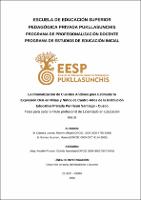
La Dramatización de Cuentos Andinos para Estimular la Expresión Oral en Niñas y Niños de Cuatro Años de la Institución Educativa Privada Puririsun Santiago - Cusco
Fecha
2026-04-14Metadatos
Mostrar el registro completo del ítemResumen
La tesis “La dramatización de cuentos andinos para estimular la expresión oral en niñas y niños de cuatro años de educación inicial” busca demostrar la eficacia de la dramatización como estrategia pedagógica para fortalecer la expresión oral en la etapa preescolar. Parte de la necesidad de valorar la oralidad como base de los aprendizajes posteriores, ya que, aunque los docentes emplean cuentos y dramatizaciones, muchas veces no aprovechan plenamente su potencial educativo. Se diseñó y aplicó un programa de siete talleres con metodología lúdica, basado en cuentos andinos seleccionados. Cada taller siguió una secuencia lógica e integró tres tipos de actividades: verbales (orientadas a la comunicación), juegos teatrales y escenificaciones. Los resultados evidenciaron la efectividad del enfoque participativo, destacando que la dramatización y la pintura libre promovieron la imaginación, la cooperación y la expresión emocional, generando un clima positivo de aprendizaje. La investigación concluye que la expresión oral en educación inicial se construye mediante situaciones comunicativas reales entre pares. La dramatización de cuentos andinos favorece la comunicación espontánea y potencia habilidades como la escucha, la organización de ideas, la descripción, la expresión de emociones y la capacidad de dialogar y opinar. Abstract
The thesis entitled “Dramatization of andean tales to stimulate oral expression in four-year-old girls and boys in the kindergarden” aims to demonstrate the effectiveness of dramatization as a pedagogical resource to strengthen oral and communicative expression in the early years of life. This study stems from the need to highlight orality as the foundation for later learning. Although in practice teachers often use stories and dramatizations in a complementary manner, without fully tapping into their educational potential. For this purpose, a program of seven workshops was developed, using a playful methodology and selected Andean stories that contribute to the development of oral expression in four-year-old children. This program was designed in accordance with theoretical principles, and each workshop follows a logical sequence. The workshops centered on three types of activities: verbal activities that promote communication, theatrical play activities, and staging activities. The implementation of the program demonstrated the effectiveness of the playful and participatory approach. The dramatization activities and free-painting moments encouraged imagination, cooperation, and the free expression of emotions, generating a positive learning environment for both children and the teacher.The research shows that the development of oral expression in early childhood education is constructed through participation in real communicative situations with peers. The dramatization of Andean stories constitutes a privileged pathway, as it not only fosters spontaneous oral communication but also stimulates other essential competencies such as attentive listening, sequential organization of events, character description, expression of emotions and preferences, and the ability to express opinions and engage in dialogue with others.
Keywords: Dramatization, Andean tales, Oral expression. Pisi Rimayllapi Willasayki
Kay qillqasqa sutichasqa “Aranway willakuykuna andesmanta tawa watayuq wawakunapa rimay kawsayta kallpachinapaq” rikuchiyta munan allin aramwayta yachachina ruwaynin hina, allin rimaynapaq. Kay yachayqa, ñaupaq, rimaynata wiñachiyta munan. Yachachiqkunaqa, willakuykuna hina aranwaykunataqa, yanapakuy hina ruwanku, ichaqa aswan pisi kutipiqa mana tapukuypi, mana imayna kallpanchanku, nisqapiqa chayqa mana chaskikusqanchu. Kay rikhuykuna qatiqpi. Chayrayku ruwasqa qanchis tallerkuna, kusisqa, pukllasqa ruwanakunawan; andino willaykuna akllasqa, tawa watayuq wawaqkunapa rimayninta wiñachinapaq. Kay programaqa yuyaymanta ruwasqa, sapa tallermantaqa chiqan ñanpi purin, hinallataq sapa tallerqa ima ruwanakunataq chiqan yanapawan kananpaq ruwasqa. Tallerkunaqa kimsa ruwanakunapi purirqan: rimay kallpachinapaq ruwanakuna, aranwa-pukllay ruwanakuna, chaymanta rikuchinapaq ruwanakuna. Kay ruwanakunaq apaykuyqa qhawarichirqan pukllasqa, masinchakuq, yanapakuq yachaypa allin kasqanta. Watuchinakuna ruwanapa, lliw pintura kawsaypas wawakunapi yuyayninta kicharirqan, masinchakunapa yanapaynin, kusichaynin; chaymi allin yachay kawsayta wawakunapaq, yachachiqpaqpas ruwarin. Kay yachayqa qhawarichin rimay kawsayqa ñawpaq yachay wasipi ima llapan rimanakuykuna chaymi ruwaspa wiñakun. Andino willaykuna watuchisqaqa hinañam ñawpaq ñan hina rimanakuyta kallpachin, mana chaylla rimaychu, ichaqa uyariy allinchasqa, ruwasqa imaykunapa siq’isqa willaynin, runakunapa tullusqan rimaynin, kusisqan, llakisqan willayninpas; chaymanta masinchakunawan rimakuy, yuyaykunata taripay, rimanakuyta wiñachiypas chanikun.
Chanin rimaykuna: Aranway, Willakuy Andino Nisqa, Rimay.
Colecciones
- Educación Inicial [29]

Excepto si se señala otra cosa, la licencia del ítem se describe como http://purl.org/coar/access_right/c_abf2