



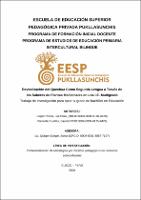
Revitalización del Quechua Como Segunda Lengua a Través de los Saberes de Plantas Medicinales en una I.E. Multigrado
Fecha
2026-07-16Metadatos
Mostrar el registro completo del ítemResumen
El presente trabajo de investigación reúne las revisiones bibliográficas sobre tres categorías importantes dentro de la EIB, empezando por el Quechua como Segunda Lengua, seguido de Plantas Medicinales, y el Aprendizaje Basado en Proyectos. Para la primera categoría se describen los trabajos de R. Cerrón Palomino, A. Torero, J. Zarco, Wiltshire entre otros, desde estos aportes se aborda el quechua como una familia lingüística, su evolución en el tiempo para comprender cómo ha llegado a ser una lengua que requiere de revitalización. Para la segunda categoría Plantas Medicinales consultamos la bibliografía de Huayllani, Puma, Mantilla, Olazabal, Jaramillo entre otros, para explicar la función de las plantas medicinales dentro del mundo andino, definiendo su importancia desde la etnobotánica como fuente de estudio que vincula los saberes ancestrales los cuales son importantes dentro de la educación intercultural. En la tercera categoría se ha desarrollado el Aprendizaje Basado en Proyectos (ABP), considerando a Tapia et al, Sotomayor et al, Aguanachi entre otros, quienes proponen, como una filosofía más que método o estrategia educativa, de esta manera el aprender haciendo va más allá de las aulas y se propone como una alternativa eficaz para incluir saberes y prácticas en un aprendizaje significativo. Abstract
This research study compiles bibliographic reviews for three important categories within Intercultural Bilingual Education (IBE), started with Quechua as a Second Language, followed by Medicinal Plants, and Project-Based Learning. The first category, the works of R. Cerrón Palomino, A. Torero, J. Zarco, Wiltshire, among others, are described. Based on these contributions, Quechua is approached as a linguistic family, tracing its historical evolution in order to understand how it has become a language that requires revitalization. The Medicinal Plants category, use the bibliographies of Huayllani, Puma, Mantilla, Olazabal, Jaramillo, among others, were consulted to explain the role of medicinal plants within the andean worldview. Their importance is defined from the perspective of ethnobotany as a field of study that connects ancestral knowledge, which is essential within intercultural education. The third category, Project-Based Learning, considers the contributions of Tapia et al., Sotomayor et al., Ahuanachi, among others, who propose PBL as a philosophy rather than merely a method or educational strategy. In this way, learning by doing goes beyond the classroom and is presented as an effective alternative for integrating knowledge and practices into meaningful learning.
Keywords: Quechua as a second language, Medicinal Plants, Ancestral Knowledge, Learning Projects. Pisirimayllapi Willasayki
Kay llamk´ay k´uskirisqaykupi qhawariyku imaynatan ñawpaqmanta pacha ayllupi hampinakunchik quranchikkunawan chay raykun kay llank´aypi qhawarimuyku kinsa t´aqapi: Huk capitulo nisqapi Qichwa simi yachanapaq, t´ikarichinapaq , riqsirichinapaq mashkarimuyku qhillqakunamanta, llank´ayniyku kallpacharinapaq, chaymanta iskay capitulo nisqapitaq ham´pi qurakunap ayllupi yachayninmanta hinallataq kinsa capitulo nisqapitaq Aprendizaje Basado en Proyecto nisqata yachay wasipi wawakunawan chay yachaykunata chaninchariyku. kinsantin llamk´aypin qhawarikun Qichwa simi rimakun wakin suyukunapi chaymantapas imaynan karqan ñawpaq pachapi kay rimaykuna yachaykuna imaynatataq kunan rimakun, imanaqtin kallpachana kachkan, hinallantaq tukuy yachay hampi qurakuna kawsaynin, yachaynin ayllunchiskunapi ñuqanchiswan kuska,kawsan chayta imaynatan waq tukuy ayllukunapi tiqsikunapi hatun yachaqkunamanta riqsiqkunanta, chaymantataq kay yachaykuna imaynatan aparikunman tukuy yachay wasikunaman, chayraykun Aprendizaje basado en proyectos nisqawan qhawarichikun kay yachaykuna Qichwa simi rimay, ruwaspa yachay wasipi, ayllu ukhupi chaymantapas llapan yachaykuna kawsaqkunawan ruwarispa, rimariyuspa, chay rayku kay yachaykunata q´imirina tukuy yachay wasipi astawan yachachikunanpaq lliw imaymana ñawpaq ayllukunaq qhapaq kawsayñikuwan kallpacharinapaq.
Chanin rimaykuna: Qhichwa simi, Hampi qura, Ayllu Yachay, Aprendizaje Basado en Proyectos.
Colecciones

Excepto si se señala otra cosa, la licencia del ítem se describe como http://purl.org/coar/access_right/c_abf2